GARR

WiFi Terms of service

10 December 2016 | GARR

The WiFi service of the Consortium GARR provides connectivity to the wireless network to:

  1. GARR Staff;
  2. Visitors whose organization is in eduroam federation;
  3. Visitors whose organization is in IDEM federation to which the only eduPersonTargetedID attribute is required;
  4. Guests after the creation of the temporary credentials by the Secretariat;

Terms of Service

PLEASE READ THIS AGREEMENT CAREFULLY BEFORE ACCESSING THE SERVICE. BY ACCESSING THE SERVICE, YOU AGREE TO BE BOUND BY THE TERMS AND CONDITIONS BELOW. IF YOU DO NOT WISH TO BE BOUND BY THESE TERMS AND CONDITIONS, YOU MAY NOT ACCESS OR USE THE SERVICE.

Users shall make use of IT resources safeguarding their integrity and ensuring the proper functioning.
Hence, the following activities are prohibited:

  1. activities that contravene the national and international law, in breach of Community legislation or are not permitted by the ordinary usage of the networks and the services provided;
  2. unauthorized commercial activities, or any other profit-making activities. The transmission of commercial and/or spamming advertising material, as well as the use of its resources by third parties for such activities;
  3. activities liable to damage, destroy, jeopardize the security of GARR IT resources, or aimed at breaking the privacy and/or at damaging third parties, including the creation, transmission and preservation of images, data or any other material that is offensive, obscene, defamatory, indecent or likely to undermine human dignity, especially when relevant to sex, race, religion, political opinions or personal and social condition;
  4. activities in conflict with other institutional aims;
  5. any other illegal activity.

You agree that the Consortium GARR cannot guarantee the safety of your traffic across its network. It may be possible that the transmitted and/or received data can be lost, damaged, or stolen while connected to the network.
You agree that the Consortium GARR has the right to monitor and log electronically your activity in using the service from time to time and to disclose any information as may be necessary to satisfy any law, regulation or other governmental request, to operate the service properly, or to protect itself or its users.

Contacts

For every need you can write to This email address is being protected from spambots. You need JavaScript enabled to view it.

International Network

21 November 2016 | GARR

The GARR network is interconnected with the global Research and Education Networks. Together with the other National Research and Education Networks (NRENs) in Europe, GARR is a member of the organization managing and operating GÉANT, the state-of-the-art fibre “super-backbone” which interconnects all European R&E networks with multiple high-capacity links up to 100Gbps.

GÉANT interconnects globally with North and Latin America, Asia, Africa, and Australia and, thanks to dedicated connectivity projects, it can reach even the most remote regions and allow European researchers to access some unique research facilities.

Interconnecting to GÉANT and contributing to shape its evolution are key features that GARR offers to its users, as it allows them to be part of large international research projects and enables multidisciplinary collaborations worldwide.

With over 50 million users, GÉANT is currently one of the most complex and widespread networks in the world. It is a dual layer (transmission and IP) network offering not only high bandwidth connectivity, but also advanced network services like direct optical links in an international multidomain environment. In this way, the NRENs and GÉANT can meet the demands of the most advanced user communities worldwide, e.g. the HEP, radioastronomy and supercompunting communities.


  • The European GÉANT backbone

    GÉANT in the high-capacity pan-European backbone which interconnects the European National Research and Education Networks with multiple 100 Gbps links and offers advanced services to large research infrastructures and to the European research, education and cultural community at large. To date, GÉANT interconnects over 50 million users in nearly 10.000 scientific, cultural and education organizations across the continent. Thanks to leading-edge technologies, more than 1000 Terabytes of data are transferred every day over GÉANT.

    100 Gbps circuits are now available across the core network, with a network designed to support up to 8 Tbps (terabits per second), ensuring that the network remains ahead of user demand and the data deluge.
    GÉANT boasts very high availability levels and an efficient management of operations that guarantees rapid resolution for any outage, thanks in part to the collaboration with all European NRENs .

    GÉANT, now in its fourth generation, is jointly funded by the EC and by the European NRENs, including GARR. The NRENs guide its operation and evolution though its governing bodies.
    GÉANT’s infrastructure and services are constantly evolving, thanks to the joint research carried out in part through specific EC-funded projects: thus for 20 years GÉANT and the European NRENs have been at the forefront of Telecommunication Technology and continue to support the R&D community’s network requirements across Europe.

    European topology map of GÉANT - March 2025

    Map updated to March 2025

    Download European topology map (PDF)

    Technologies

    GÉANT is one of the largest Research and Education Networks in the world, offering dedicated support to diverse user communities, with services spanning from commodity IP connectivity to the implementation of full-fledged Optical Private Networks in an international multidomain environment. As with GARR’s National infrastructure, in GÉANT we can also distinguish three layers: physical, transmission and IP/MPLS. The physical layer is based on dark fibres, while the transmission layer is based on the Infinera technology, which already allows to deploy 500 Gbps superchannels and offer dedicated lambdas to particularly demanding users or projects. Last but not least, the packet layer supports level 2 and 3 services, thus providing both Ethernet links and IP connectivity.

  • Cross border fiber

    Most of GARR’s direct international connectivity for research passes through GÉANT. However, thanks to Italy’s geographical position, some direct connections with neighbouring Countries have also been established.

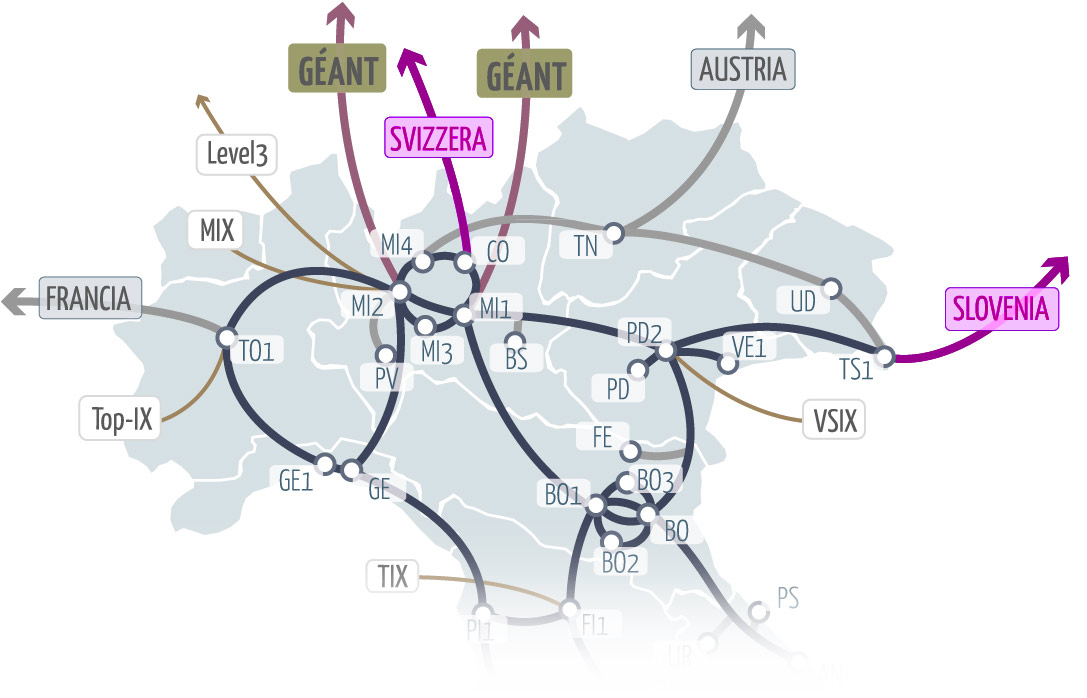
    These links, known as Cross-Border Fibres, are complementary to the interconnection with GÉANT, aiming on one hand to channel direct traffic between two neighbouring Countries, often for the benefit of specific collaborations, and on the other to provide mutual backup in the (unlikely) case of temporary unavailability of one of the Countries’ links to GÉANT.

    Currently, Cross-border fibres are active with Switzerland and Slovenia, while the design of a CBF with France is ongoing.

    Cross Border Fiber map
  • Intercontinental connectivity

    Thanks to its numerous collaborations and intercontinental extensions, GÉANT and the European NRENs are interconnected with over 100 Countries worldwide.

    GÉANT directly manages specific connectivity projects with the Mediterranean region, Africa and Central Asia and participates in connectivity projects between Europe and Latin America, the Caribbean, the Far East and the Asia Pacific region. Last but not least, a long-standing collaboration ensures high quality interconnections with North American R&E networks, i.e. Internet2 and ESnet for the US and CANARIE for Canada.

    European topology map of GÉANT

    Map updated to March 2025

    • vai al sito di GÉANT - Connettività internazionale
    • Download European topology map (PDF)

Network access rules

15 June 2016 | GARR

The GARR network is the national digital infrastructure dedicated to the university and research community. It is reserved for universities and institutions whose missions include research, education, training and cultural activities. The GARR network is the only national research network and forms part of the European research network GÉANT (Legislative Decree no. 218 of 25/11/2016 Art. 10 paragraph 5).

National and international organisations based in Italy whose missions include research, education, training and cultural activities may request connection to the GARR network.

Who can request connection

The network service is primarily intended for the scientific community and, in particular, for:

  1. the founding member institutions of the GARR Consortium (CNR, ENEA, INFN and the CRUI Foundation), as well as entities belonging to other membership categories provided for in the GARR Statute and listed on the GARR Member Institutions page
  2. research organisations supervised by the Ministry of Universities and Research (MUR);
  3. the inter-university consortium CINECA;
  4. associations or consortia composed of organisations referred to in the points above.

Based on agreements or contracts with the GARR Consortium, access to the GARR network may also be granted to the following:

  1. institutions of Higher Artistic, Musical and Dance Education (AFAM) and state schools;
  2. foreign universities and cultural and/or scientific institutions based in Italy for which agreements exist with the Italian Government;
  3. research organisations supervised by other ministries;
  4. public administration institutions involved in the experimentation and development of advanced information and telecommunications technologies;
  5. Italian cultural and/or scientific institutions of significant interest to the national scientific and academic community;
  6. other entities carrying out research activities in Italy and engaged in collaborations with the GARR community, limited to the duration of the collaboration.

Use of the GARR network is, in all cases, subject to compliance with the rules on proper use and conduct set out in the Acceptable Use Policy (AUP).

How to request connection

Organisations interested in obtaining access must submit a formal request addressed to the President pro tempore of the GARR Consortium and send it by email to: This email address is being protected from spambots. You need JavaScript enabled to view it..

The request must include:

  • the structure of the requesting institution or organisation;
  • a description of its institutional purposes and the activities carried out;
  • the purposes for which access to the university and research network is requested;
  • any ongoing scientific or project collaborations with other institutions belonging to the Italian scientific and academic community;
  • the planned methods for using the GARR network and, where available, preliminary technical requirements.

Evaluation of the access request

The request is evaluated by the institutional bodies of GARR, which verify compliance with the GARR network access rules.

The outcome of the evaluation is communicated to the organisation by the Institutional Secretariat via email.

Technical and financial proposal for access

If authorisation is granted, GARR prepares a proposal including:

  • the technical design for implementing the infrastructure connecting the site to the GARR network, in line with the connectivity and service requirements expressed by the organisation;
  • a description of the operational, application and advanced services made available;
  • the related costs.

Formalisation and activation of services

The implementation phase of the connection infrastructure and the activation of services are subject to the signing of a Connectivity Services Agreement between the organisation and the GARR Consortium.

Further information

For preliminary information, please contact GARR at This email address is being protected from spambots. You need JavaScript enabled to view it..

Connectivity

14 June 2016 | GARR

Le scuole sono connesse in diverse modalità, applicando gli stessi principi validi per tutti gli enti GARR, vale a dire utilizzo, laddove possibile, della fibra e banda minima di 100 Mbps simmetrici per ciascuna sede.
In alcuni casi l’accesso delle scuole avviene in sinergia con le reti regionali, metropolitane o di campus già presenti sul territorio in collaborazione con enti locali e università.

Accesso in modalità diretta

La modalità diretta prevede l’accesso alla rete attraverso tecnologie su fibra ottica spenta con attestazione presso un Punto di Presenza (PoP) della rete GARR, con banda fino a 1 Gbps o con aggregazione attraverso un PoP di un operatore di telecomunicazione. Per questi accessi il profilo di banda offerto è simmetrico e pari a 100 Mbps in upload e download e può essere prevista la fornitura di apparati di rete. Tra i servizi offerti c’è l’assegnazione di indirizzi IP pubblici GARR che consentono agli istituti scolastici di realizzare una rete aperta direttamente visibile dalle destinazioni Internet nazionali ed internazionali, con la possibilità di ospitare servizi (siti web, posta elettronica, videoconferenza) e di rendere ogni utente singolarmente presente sulla rete.

Accesso in modalità indiretta

La modalità indiretta prevede la realizzazione del collegamento d’accesso, denominato a livello 3 (L3), attraverso un soggetto ospitante. In questo caso viene utilizzata la stessa capacità di banda del soggetto ospitante che può essere un ente GARR già collegato, una rete metropolitana (MAN, Metropolitan Area Network) o una rete regionale (RAN, Regional Area Network). Anche in questa modalità si può prevedere la fornitura di apparati di rete da parte di GARR e l’assegnazione di indirizzi IP pubblici direttamente da GARR o appartenenti al soggetto ospitante.

Caratteristiche del servizio di connettività alla rete GARR

Per entrambe le modalità, GARR prevede:

  • la fornitura di circuiti ad alta capacità
  • la fornitura di servizi ad alto valore aggiunto
  • la disponibilità di personale competente in fase di apertura guasti e per contatti di tipo informativo sui servizi erogati
  • livelli di tolleranza ai guasti e contenimento dei tempi di fermo in caso di guasti e malfunzionamenti
  • la fornitura di un apparato di accesso preconfigurato
  • la fornitura di assistenza e manutenzione e per hardware fornito

GARR Founding Members

21 January 2016 | GARR
  • Consiglio Nazionale delle Ricerche
  • Agenzia nazionale per le nuove tecnologie, l'energia e lo sviluppo economico sostenibile
  • Fondazione CRUI
  • Istituto Nazionale di Fisica Nucleare
  • Consiglio Nazionale delle Ricerche

    Il Consiglio Nazionale delle Ricerche (CNR) è Ente pubblico nazionale di ricerca con competenza scientifica generale, vigilato dal Ministro dell'Istruzione, dell'Università e della Ricerca (MIUR). È dotato di personalità giuridica di diritto pubblico e di autonomia scientifica, finanziaria, organizzativa, patrimoniale e contabile. Il CNR, in un quadro di cooperazione e integrazione europea, ha il compito di svolgere, promuovere, trasferire, valutare e valorizzare ricerche nei principali settori della conoscenza. E di applicarne i risultati per lo sviluppo scientifico, culturale, tecnologico, economico e sociale del Paese. La rete scientifica del CNR è composta da oltre 100 Istituti, articolati in 7 Dipartimenti, con circa 8.000 dipendenti. Le dimensioni, l'articolazione e la diffusione su tutto il territorio nazionale fanno del CNR il più grande Ente di ricerca italiano, caratterizzato da un elevato grado di multidisciplinarietà che lo distingue da tutti gli altri Enti, e uno dei maggiori a livello internazionale.

    Vai al sito

  • Agenzia nazionale per le nuove tecnologie, l'energia e lo sviluppo economico sostenibile

    La Legge 99 del 2009 affida all’ENEA - Agenzia nazionale per le nuove tecnologie, l'energia e lo sviluppo economico sostenibile attività finalizzate "alla ricerca e all’innovazione tecnologica nonché alla prestazione di servizi avanzati nei settori dell'energia, con particolare riguardo al settore nucleare e dello sviluppo economico sostenibile". L’Agenzia è impegnata numerosi settori quali Efficienza energetica, Fonti rinnovabili, Ambiente e clima, Sicurezza e salute, Nuove tecnologie, Ricerca di Sistema Elettrico e dispone di competenze multidisciplinari ad ampio spettro e di una consolidata esperienza nella gestione di progetti complessi. Grazie a impianti sperimentali, laboratori specializzati e strumentazioni di eccellenza, l'ENEA sviluppa nuove tecnologie e applicazioni avanzate; fornisce servizi ad alto contenuto tecnologico, studi, misure, prove e valutazioni; svolge attività di formazione e informazione sulle attività di propria competenza per trasferire la conoscenza dei risultati ottenuti valorizzarli a fini produttivi. Dal 1 luglio è operativa la nuova struttura organizzativa, basata su tre dipartimenti Fusione e Tecnologie per la Sicurezza Nucleare, Tecnologie Energetiche, Sostenibilità dei sistemi produttivi e territoriali. Vi sono inoltre l'Unità Tecnica Efficienza Energetica che ricopre il ruolo di Agenzia Nazionale per l’Efficienza, l'Unità Tecnica Antartide, l'Istituto di Radioprotezione, l'Unità Certificati Bianchi e l'Unità Studi e Strategie.

    Vai al sito

  • Fondazione CRUI

    Forniamo servizi e consulenza ai maggiori interlocutori istituzionali del Paese per trasferire l’innovazione universitaria nei settori chiave di sviluppo. Nati nel 2001 come braccio operativo della Conferenza dei Rettori delle Università Italiane, abbiamo raccolto nello stesso anno la nostra prima grande sfida: CampusOne, il più ambizioso progetto di sperimentazione della riforma universitaria, sostenuto da un finanziamento governativo di oltre 100 milioni di euro, che ha coinvolto 70 Atenei, 500 corsi di laurea, 9.000 docenti e 50.000 studenti nell’intento di innovare l’Università italiana. Da allora le sfide si sono susseguite numerose aprendosi a nuovi ambiti e nuovi attori, per la realizzazione di progetti fondati sul patrimonio di conoscenze e competenze del sistema universitario, ma rivolti anche ai decisori esterni. Abbiamo così sviluppato un’identità dinamica e flessibile che ci rende oggi un robusto ponte tra l’Università e il Paese.

    Vai al sito

  • Istituto Nazionale di Fisica Nucleare

    L’INFN è l’ente pubblico nazionale di ricerca, vigilato dal Ministero dell’Istruzione, dell’Università e della Ricerca (MIUR), dedicato allo studio dei costituenti fondamentali della materia e delle leggi che li governano. Svolge attività di ricerca, teorica e sperimentale, nei campi della fisica subnucleare, nucleare e astroparticellare. Le attività di ricerca dell’INFN si svolgono tutte in un ambito di competizione internazionale e in stretta collaborazione con il mondo universitario italiano, sulla base di consolidati e pluridecennali rapporti. La ricerca fondamentale in questi settori richiede l’uso di tecnologie e strumenti di ricerca d’avanguardia che l’INFN sviluppa sia nei propri laboratori sia in collaborazione con il mondo dell’industria. L’INFN è stato istituito l’8 agosto 1951 da gruppi delle Università di Roma, Padova, Torino e Milano al fine di proseguire e sviluppare la tradizione scientifica iniziata negli anni ‘30 con le ricerche teoriche e sperimentali di fisica nucleare di Enrico Fermi e della sua scuola. Nella seconda metà degli anni ‘50 l’INFN ha progettato e costruito il primo acceleratore italiano, l’elettrosincrotrone realizzato a Frascati dove è nato anche il primo Laboratorio Nazionale dell’Istituto. Nello stesso periodo è iniziata la partecipazione dell’INFN alle attività di ricerca del CERN, il Centro europeo di ricerche nucleari di Ginevra, per la costruzione e l’utilizzo di macchine acceleratrici sempre più potenti. Oggi l’ente conta circa 5000 scienziati il cui contributo è riconosciuto internazionalmente non solo nei vari laboratori europei, ma in numerosi centri di ricerca mondiali.

    Vai al sito

  • Consiglio Nazionale delle Ricerche
  • Agenzia nazionale per le nuove tecnologie, l'energia e lo sviluppo economico sostenibile
  • Fondazione CRUI
  • Istituto Nazionale di Fisica Nucleare
(function(UIkit){ var $ = UIkit.util; var selSlideshow = '#wk-4ca [uk-slideshow]'; var selSwitcher = '#wk-4ca [uk-switcher]'; var selSwitcherTarget = '#wk-4ca .uk-switcher'; $.on(document, 'show', selSwitcherTarget, function(e) { if (slideshow().getIndex() !== switcher().index()) { slideshow().show(switcher().index()); } }); $.on(document, 'itemshow', selSlideshow, function(e) { if (slideshow().getIndex() !== switcher().index()) { switcher().show(slideshow().getIndex()); } }); function slideshow() { return UIkit.getComponent($.$(selSlideshow), 'slideshow'); } function switcher() { return UIkit.getComponent($.$(selSwitcher), 'switcher'); } })(window.UIkitwk || window.UIkit);

Access Port Managers (APMs)

14 January 2016 | GARR

Each entity connected to the GARR Network has its own local manager, the APM (Access Port Manager), which manages the connection with the GARR network and is the technical reference person at the GARR for its establishment.

  • Who is the APM: definition
  • Technical qualifications of an APM
  • Duties of an APM towards GARR
  • Duties of GARR towards an APM
  • Find your APM

Who is the APM: definition

An Access Port Manager (APM) is the technical reference to the GARR of the entire site belonging to a body authorized to access the GARR Network.

The APM is the only technical contact point between the site it belongs to and the Operative and Application Services that are an integral part of the GARR Network, such as:

  •  Network Operation Center (GARR-NOC)
  •  Computer Emergency Response Team (GARR-CERT)
  •  Local Internet Registry (GARR-LIR)
  •  GARR Domain Names Maintainer (GARR-NIC)
  •  GARR News Service (GARR-NEWS)
  •  GARR Mirror Service (GARR-MIRROR)

Technical qualifications of an APM

The APM, with the possible support of colleagues and/or collaborators, must possess some basic technical knowledge sufficient to perform directly the requested role. If necessary the APM, under its own responsibility, can collaborate with managers of other services operating within its own site.

In particular, the APM:

  •  must be able to access the access router of your site in a simple and privileged way to the GARR network;
  •  must be aware of the basics of IP routing;
  •  must be able to configure at least static routes and filters on your router;
  •  must be able to perform simple functionality checks of its interconnection equipment at GARR;
  •  must possess the basic knowledge on the interconnection hardware to GARR installed on its site;
  •  must know the basic principles of security in network services;
  •  must be able to perform ordinary operations on the configuration of Domain Name Servers (DNS);
  •  must know the basic principles of operation of the e-mail service and be able to intervene on the configurations of the e-mail servers of your site.

Duties of an APM towards GARR

The GARR indicates some behavioral rules to ensure that the APM can effectively carry out its activities and actively cooperate in the proper functioning of the network. In particular, the APM is required to:

  •  be aware of the technical procedures relating to the operational services provided by the GARR network and illustrated on the respective GARR websites (in particular those of GARR-NOC www.noc.garr.it and GARR-CERT www.cert.garr.it);
  •  view the technical documentation made available on the GARR websites;
  •  in the event of an emergency and the impossibility of making himself available for extraordinary events, report to the GARR Directorate, in agreement with the APA, at least one of his substitutes;
  •  keep updated the information related to his networks and domain so that the databases involved are always up-to-date and consistent with the existing one;
  •  participate in the technical meeting days proposed by GARR;
  •  check any ticket issued by GARR-NOC for interruptions on the backbone, from GARR-CERT for security issues and any other service of the GARR Network, and disclose such information internally;
  •  enable the e-mail address apm@domain for him/her, preferably corresponding to an internal mailing list including his/her own collaborators;
  •  enable on the router access to the GARR network the non-privileged password, filters and IP services required by GARR-NOC as documented on the GARR-NOC website;
  •  interact with the GARR Directorate (This email address is being protected from spambots. You need JavaScript enabled to view it. - ​​www.garr.it) to keep updated information about himself, such as name, phone, address, e-mail (apm@domain);
  •  interact with the GARR NOC (This email address is being protected from spambots. You need JavaScript enabled to view it. - ​​www.noc.garr.it) for:
    • reports of malfunctions;
    • definition of the routing during the activation phase of the site or for request of variations of the same;
    • notifications of scheduled interruptions of the network border router;
    • request for more general technical information on the GARR network;
    • possible assignment of a private AS number.
  •  interact with the GARR NIC (This email address is being protected from spambots. You need JavaScript enabled to view it. - ​​www.nic.garr.it) for:
    • requesting a domain name that requires registration at the Registry (ccTDL ".it"), EURID (cc TDL ".eu") and the GARR database for the site;
    • request for a secondary name server service for your domain names;
    • changes relating to registration with the Registry, EURID and the GARR database of their domain names.
  •  interact with the GARR LIR (This email address is being protected from spambots. You need JavaScript enabled to view it. - ​​www.lir.garr.it) for:
    • requesting new network blocks (IPv4 and IPv6) for the site;
    • requesting for a secondary name server service for the resolution of the networks;
    • changes relating to the registration on the RIPE and GARR databases of their IPv4 and IPv6 networks.
  •  interact with the GARR CSIRT (This email address is being protected from spambots. You need JavaScript enabled to view it. - ​​www.cert.garr.it) for:
    • reporting of network security issues;
    • the configuration / cancellation of any filters requested by the GARIR CSIRT.

Duties of GARR towards an APM

To effectively assist the APM in the withdrawal of its business, GARR is responsible for:

  •  providing assistance for the connection to GARR and agree with the APM the modalities of the connection itself;
  •  providing assistance after connecting to GARR for any problem concerning network interfacing;
  •  providing assistance after connecting to GARR for any problem concerning routing;
  •  providing support in the management of security incidents;
  •  keeping the statistics relating to the connection of the site belonging to the APM visible;
  •  making available on its websites all the technical information necessary for the proper performance of the role of an APM;
  •  keep the APMs informed of any planned interruptions) on the backbone through appropriate notices (opening and closing of the so-called "Trouble Tickets");
  •  keep the APM informed of any interruptions scheduled on the backbone through the opening and closing of Trouble Tickets;
  •  interacting with the APM for any problem concerning the technical functionality of a site, including routing, security, maintenance of information on national and international databases;
  •  advertising on their websites the meeting days organized by GARR.

Find your APM

Through the search procedure "Find your APM" you will be able to find the references of the Access Port Manager - APM of the institutions connected to the GARR network.

torna su